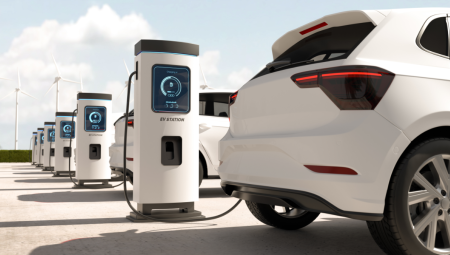


International. The global market for direct current (DC) fast chargers for electric vehicles is going through a phase of accelerated expansion, driven by the sustained increase in the adoption of electric mobility and the need for high-power charging infrastructure.
According to a recent report by MarkNtel Advisors, this market will grow from an estimated value of $7.19 billion in 2025 to about $75.49 billion in 2032, with a compound annual growth rate (CAGR) of 32.11% between 2026 and 2032.
The study notes that the industry is transitioning from an initial stage of deployment to a massive scaling phase, in line with the growth of electric fleets and the demand for long-distance travel. In 2024, more than 1.3 million public charging points were added globally, consolidating a base that continues to expand rapidly.
In terms of infrastructure, public charging stations lead the market with close to 60% share in 2026, favored by government programs, road corridors and large-scale charging networks that seek to reduce users' "autonomy anxiety". For its part, the commercial segment concentrates around 48% of the market, driven by the electrification of public transport, logistics fleets and cargo vehicles.
Regionally, Asia-Pacific dominates the market with an approximate 46% share, thanks to China's leadership in both electric vehicle production and charging infrastructure deployment. This region also concentrates a large part of the manufacture of equipment and components, which facilitates the expansion of high-power charging networks.
The report also highlights technological and strategic developments within the sector. Companies such as Eaton Corporation have developed fast-charging solutions geared toward commercial fleets, while Blink Charging Co. has expanded its production capacity and station network, including chargers of up to 240 kW for road corridors and commercial sites.
Among the main trends, the integration of renewable energies and energy storage systems in fast charging stations stands out. This combination makes it possible to reduce the pressure on electricity grids, optimize operating costs and improve the resilience of the system, especially in high-power installations that can demand energy equivalent to dozens of homes.
Nonetheless, the growth of the market faces significant challenges. High upfront installation costs and power grid modernization needs continue to be a significant barrier. Implementing a fast charger can range from $40,000 to $100,000, while ultra-fast charging systems can exceed $200,000 per site, especially when they require upgrades to transformers and electrical infrastructure.
Despite these challenges, the market outlook remains solid, supported by public policies, technological advances and the sustained growth of the electric vehicle fleet worldwide.