

In automotive refinishing, the shine is not born in the cabin, but much earlier, in silent stages that rarely star in conversations. Sandpaper, discs and ribbons – tools invisible to the common eye – determine whether a finish seduces for years or disappoints in weeks.
By Zona de Pinturas Magazine and Aftermarket International Magazine
Behind each impeccable color there is a train of precise preparation, quality supplies and hands that know the trade to the millimeter.
Automotive paint, that final coat that seduces with its shine and protects with its composition, is rarely associated with everything that happens before the color touches the body. However, behind the perfect finish that everyone admires, there is an invisible, rigorous, and deeply technical science that defines the success or failure of any refinish job.
In the words of Juan Fernando Velásquez, Abracol's export director: "The preparation of a piece, to ensure good quality, is to ensure good preparation." And that preparation begins long before you put color into practice.
More than aesthetics: technical and professional character
In the world of repainting, beauty is not enough. Technical precision and professional discipline are the true art. To achieve clean, uniform surfaces with high adhesion, the refinisher relies on essential tools such as red sandpaper, Velcro disc and automotive tape. These inputs, discreet and often invisible to the untrained eye, make the difference between a part that stands the test of time and one that requires costly rework.
"What is the last thing you do in a car? What is the first thing you perceive when marketing it? "Painting," Velásquez proposes with a persuasive logic. Everything is absorbed through the eyes, but the final outcome is not based solely on color. It is the product of a series of previous technical stages, carried out meticulously.
The crucial role of sanding: precision from the start
Sanding techniques have evolved. Traditional wet sanding with conventional papers has given way to cleaner, more efficient and controlled dry sanding. In this process, red sandpaper represents a key breakthrough: its heat-treated grain provides greater durability and consistent abrasion, while its zinc stearate coating prevents plugging, allowing for smoother and faster preparation.
"Today they hide it a lot with pearls and those chameleonic colors," Velásquez acknowledges, "but if you don't comply with a perfect sanding train on good raw materials... something is going to go wrong." A lack of proper preparation doesn't just affect aesthetics: it can lead to defects such as bubbles, opacity, uneven tones, or even premature peeling off of paint.
Velcro disc: uniformity and control in every movement
The Velcro disc is another fundamental ally. It allows you to work with precision on flat and curved surfaces, guaranteeing uniformity and avoiding vibrations that generate imperfections. Its design ensures a firm fit to the pad, a key condition to maintain stability in the sanding process.
"The success of the velcro of our red sandpaper in Abracol is that it does not run, it ties very well. A bad pad generates scratches, imperfections that are only seen at the end of the process," says Velásquez. The combination of a good pad and a quality disc ensures a uniform base, crucial for the correct application of primaries, color and final varnish.
Automotive tape: precise delineation
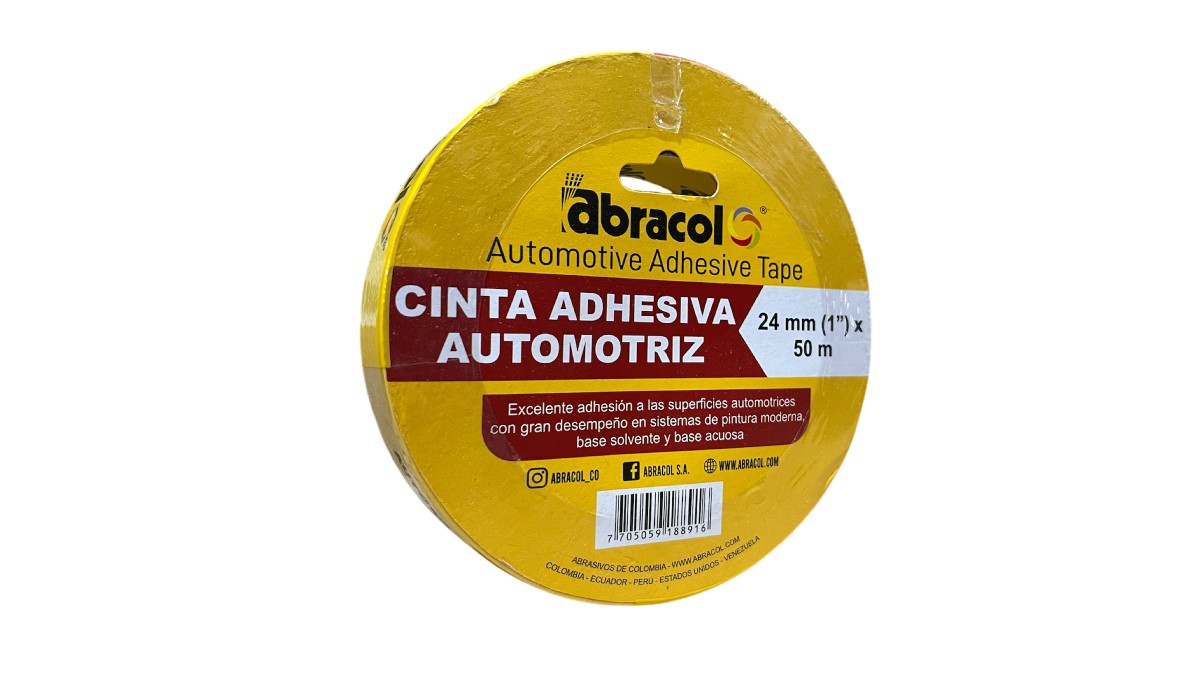
The masking process is just as important as any pre-painting step. ABRACOL automotive tape prevents the coating from invading unwanted areas and allows for the generation of defined lines and clean finishes. In workshops without pressurized booths or with limited conditions – a common reality in many regions of Latin America – their role is even more critical.
Poor quality tape can melt in the heat of the oven or leave residue, ruining the surface. "What depends on a good tape is a good backing and a good glue, and that guarantees you from experience and from the support of the company that sells it that you have a good product, that it will not melt and that it will outline you," says Velásquez.
The importance of respecting the sanding train in surface preparation
For those who work in automotive refinishing, every step counts. It's not just about applying paint or achieving surface gloss: quality is at the base, especially in the rigorous respect of the sanding train.
Many errors derive precisely from the omission or alteration of this basic process.
"And you don't do the thousand jump, which is jumping from 80 to 600, because the 80 line is not going to take away from you with 600 sandpaper, because you jump a maximum of two grits: 80, 120, 180, and then you apply the putty that you sand it with 220 or 240 grits, you already have a super fine line. So people who are perfectionists rip you off with the whole train, 80, 120, 180, 240. Even if it takes longer, but the super finished... it takes a little longer, but you have a super finished product," explains the expert.
A poor choice of sandpaper or an excessive jump in grit can compromise the entire job: leaving visible pores, moisture residue, blisters in the sun and, ultimately, forcing costly rework.
"People believe that going from 80 to 220 with what you saved, what? 2,000 pesos. And how much do you charge for the paint of a vehicle? 2,000 pesos is nothing. But if you add it all up, sandpaper, tape, wallpaper is equivalent to 30%. But then you have to do all that repainting rework," Velásquez clearly warns.
Technology, technique and human talent: the triangle of excellence
Painting is not magic. No matter how advanced refinish systems are, there is no technology capable of exactly replicating the original factory finish. This has been recognized by brands such as Sherwin-Williams, Axalta and Wanda. For this reason, success in the workshop depends on a fundamental triangle: good preparation, quality inputs and trained human talent.
"It all depends on the equalizer, the painter and the detailer. The detailer gives it the shine, but if you have a good surface preparation, you don't need to polish the clearing at the end. Polishing with microphones is often to correct mistakes," says Velásquez. A well-executed job from the start avoids unnecessary corrections and prolongs the life of the finish.
Repainting in context: an industry in transformation
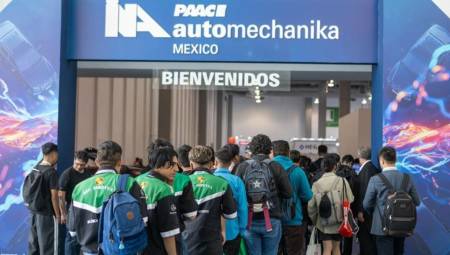
The refinish industry has evolved. The aftermarket sector is increasingly integrating professionalized processes, certified materials and technical training. Events such as Repintado by Autoamericas or Automechanika are evidence of this transformation.
"The 2024 event had 575 exhibitors from 43 countries, received 24 thousand visitors from 57 countries," says Laura Restrepo, editor of Aftermarket, underlining the importance of these meetings to connect an industry that previously operated in watertight compartments.
Manufacturers, distributors and technicians converge there with a common goal: to optimize every link in the process, from the foil to the varnish.
From polishing to the art of detailing
The rise of detailing in Latin America has also changed the way we work in small and large workshops. In the United States, where this practice is more advanced, technicians use differentiated pads, control speeds, work with specific compounds and handle millimeter sanding techniques. That experience is crossing borders.
"I like your sandpaper because it leaves the same part as 3M's. And that line is removed by the polishes. There are polishes of very good quality. He sells those from Pro, which he manufactures for Dupont in the United States," says Velásquez about a retailer in Guadalajara who today runs his own business.
Added to this is the criteria and experience of the coach. "You said something that for me is very true. It's an art. In other words, preparing a car is an art. There are no schools in the world that teach how to repaint vehicles because the cars are different, different strokes, different climates, different workmanship, different parts. The experience that you take on the street," says Velásquez with conviction.
Character before color
Ultimately, the true art of automotive refinishing doesn't start with the paint gun, but from the initial evaluation of the part. A good preparation, with the right supplies and executed by expert hands, ensures that the color not only covers, but enhances. May it not only shine, but last.
Because in the world of repainting, character comes before color.
And that character is built with technique, respect for processes and detailed knowledge of every millimeter of surface.
"When you respect the whole process you have the ideal result."